rooted in grace
Sharing in life together at The Table by rooting our lives in God’s fierce love for the world.
We lead a six-week series called “Growing in Faith” to help newcomers connect with others and learn more about how we share in life together at The Table.
“One of the scribes came near and heard them disputing with one another, and seeing that Jesus answered them well, he asked Jesus, “Which commandment is the first of all?” Jesus answered, “The first is, ‘Hear, O Israel: the Lord our God, the Lord is one; you shall love the Lord your God with all your heart, and with all your soul, and with all your mind, and with all your strength.’ The second is this, ‘You shall love your neighbor as yourself.’ There is no other commandment greater than these” – Mark 12.28-31
An urban farm & micro bakery in Sacramento finding community in soil and dough.

For my little niece, Angelina, whose art rests at the heart of this composition, and in whose joy we glimpse the Kingdom of God—alongside her sisters, Angelika and Ariana.
At the center of this work is a drawing made by my five-year-old niece, Angelina. I watched her joyfully scribble it in under three minutes, churning out drawing after drawing and handing each one to me with an eager smile. In this piece, she first drew a self-portrait (her wearing a crown), then graciously decided to include me (taking some creative liberties in giving me a third arm!).
I imagine the scene in Matthew 19: toddlers wailing, little ones slipping from their parents’ arms, parents offering apologetic glances toward the frowning disciples as the scene around Jesus grows increasingly disorderly and loud. Those of us who’ve participated in group infant baptisms and baby dedications (when one cries, the chain reaction begins!), have led children’s sermon moments with restless kids squirming about, or had the joy of watching our little ones participate in a kids’ choir performance that goes delightfully rogue, can easily relate.
The disciples, feeling the weight of being seen as serious leaders alongside their rabbi, Jesus, may have tried to preserve a sense of reverence by shooing away the parents bringing their children to him. Yet here, Jesus reorients his disciples (and us) away from the illusion of control and reminds us that it is the joyful, unruly, sincere presence of a child to whom the kingdom truly belongs. Just a chapter earlier, in Matthew 18, Jesus tells his followers that unless they become like little children, they will not even enter the kingdom. Surely the disciples thought Jesus couldn’t mean that literally—right?
While I’ve been busy making art, Angelina has been busy being an artist. I surely could learn a thing or two from her about inheriting the kingdom.
– Carmelle Beaugelin Caldwell

by Nicolette Faison
Inspired by Deuteronomy 24:17-22
16″x20″ Acrylic, marker, paper on canvas
They keep taking my neighbors. Chicago and other cities associated with the Democratic party are going through a humanitarian crisis under a fascist regime. Cars are being left vacant on random blocks and parking lots. People are being disappeared while their children are being zip-tied at 3 a.m. We clergy and religious leaders have been shot with pepper spray and rubber bullets while demanding the freedom of our neighbors. No one deserves to live like this. This piece does not truly capture the pain I hold every day, between keeping track of what is happening in Gaza, resisting fascism, and dealing with yet another economic collapse under capitalism.
But let me tell you something good. . . I still believe in humanity. When I watched people in Gaza prepare basic meals to break their fast during Ramadan during a genocide, I saw something good. When local neighbors saw our public vigil for disappeared people and chose to join us for a time of lament, I saw something good. When Colin Kaepernick paid for the independent autopsy of one of the Black men recently lynched, I saw something good. The good is people still choosing to be empathetic and compassionate in times of crisis. That is what Christ calls us to be.
The stranger who enters foreign land is often forced to flee their own home. It is rare for people to risk their entire livelihood and their family for anything other than necessity. For that reason, each portrait has a halo deeming them holy, sacred, and divine. I used sparkling gold paper to break up each distinct image. Look deeply at these portraits. The top left is inspired by the Maasai people, a nomadic group that dwells across borders. The top right image is an indigenous woman and her child, a nod to Mary and Jesus. She has a red palm across her mouth which is a tribute to Missing and Murdered Indigenous Women and “Two-Spirit” people. The bottom left is a slightly aging man from Mesoamerica. The bottom right is a woman in hijab, which is commonly targeted in Islamophobic spaces. Look at the people some consider to be a threat. Look at our neighbors. Migrants are sacred. Fuera ICE.
– Rev. Nicolette Faison

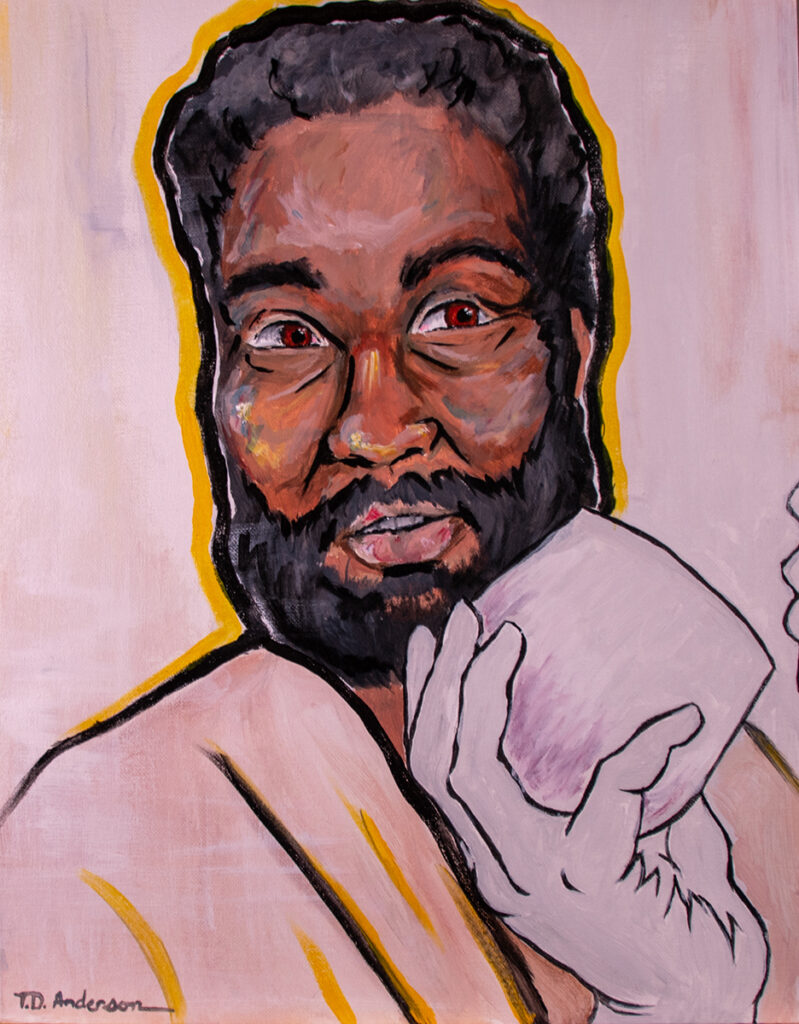
The Wedding at Cana is my favorite text because there is a lot of humor in it. There’s humor in a mother approaching her son and telling him to do something without ever actually telling him to do it. There’s his pouty resistance to his mother’s non-demand while she completely ignores him and paints him in a corner. There is humor in a raucous wedding reception where the people are so “lit” that the wine has run out. And, for me, it’s particularly humorous that there’s this huge, beautiful secret of which only a few people are aware.
Those people include Jesus’ mother and the select servants who help him pull off the miracle that inaugurates his ministry. Servants are normally meant to be inconspicuous, so I wanted to focus on the servant who goes to the chief steward with a cup full of what, as far as he’s concerned, is water.
If Jesus—whose ministry has not started, so there haven’t been any wonders associated with him yet—tells you to fill jars with water and draw from the jar to give to the chief steward, what is going through your mind at that moment? I invite the viewer to focus on this servant and all his curiosity and expectation, and think of a time when you were surprised by something God did. What actions preceded the miracle? Did it make sense? What did you know, and what was hidden from you? What “secrets” might God be keeping from you now as God works clandestinely on your behalf?
—Rev. T. Denise Anderson